
On October 22, my colleagues and I took part in a demonstration in Stockholm to read the names of the children killed in Gaza since October 7, 2023. Initiated by the Swedish Peace and Arbitration Society, the gathering was held by 23 organisations, including Human Rights Watch, Amnesty Sweden, and Oxfam.
We came together to call on Sweden to stand up for international law and for every child’s right to life. Because I have my nose to these issues every day, I thought I could keep my emotions in check; I was surprised by what happened during the protest.
At Human Rights Watch, I follow developments in Israel and Palestine closely, engage Nordic governments on policy change to address human rights violations, and share findings from our research. I read reports every day—stories of rights abuses, displacement, and loss —and I thought that, in the process of doing so, I had built a certain distance. But when it was my turn to read some of the names on the list, my legs started to shake. My voice broke. I did my best to hold back the tears, but they came anyway.
Ayla Ahmed Ali Obeid, one year old. Ahmed Mamdouh Salem Haji, two years old. I had to pause between the names and catch my breath to continue. Maria Hamza Salama Abu-Aziz, three years old.
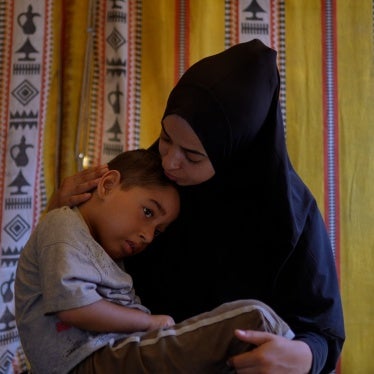
The list of 18, 726 names of Palestinian children killed in Gaza over the past two years seemed endless. Ten hours on, we’d only managed to read 5,148 names. Killed before they could take their first steps or speak their first words, many of these children never reached their first birthday. The binder in my hands, filled with lists of names, felt impossibly heavy. The latest Gaza Health Ministry figures show more than 19,000 children killed in Gaza and that is almost certainly an undercount.
This isn’t normal and we can’t let it become normal. We cannot allow ourselves to normalize the Israeli governments total disregard for international humanitarian law — not only in Gaza, but throughout the occupied Palestinian territory and neighboring countries.
Even amid a fragile ceasefire, the world should not look away. Gaza remains the deadliest place in the world for children, and one of the worst humanitarian catastrophes of our time.
A ceasefire may offer the prospect of relief, but Palestinians in Gaza will continue to suffer and die as long as Israel maintains its unlawful blockade. Children have not only been killed by airstrikes, but also by malnutrition, dehydration, and disease. Mass starvation in Gaza is entirely human-made, the result of Israel’s deliberate policy of restricting the United Nations and other humanitarian organizations from delivering desperately needed life-saving aid. The same day we gathered to read the names, the International Court of Justice (ICJ) issued an advisory opinion underscoring that such restrictions breach Israel’s obligations under international law.
The Court’s ruling comes at a critical moment, as the large-scale entry of humanitarian aid into Gaza remains restricted despite the cessation of hostilities. The ICJ underlined that Israel is obliged to let the UN do its job to ensure unhindered, life-saving aid into and throughout Gaza.
The court concluded that Israel’s allegations that the United Nations Relief and Works Agency (UNRWA) lacks impartiality is unfounded and that Israel’s obstruction of the agency’s critical work is at odds with international law. Sweden should urgently reinstate its funding to the UN agency, whose work providing life-saving support and education for Palestinian children is irreplaceable.
The Swedish government should take concrete action to press Israel to lift all remaining restrictions preventing the UN and humanitarian organizations from delivering relief for Palestinian civilians in Gaza. It should also act to ensure Israel facilitates the opening of all crossings to allow the free movement of people as well as the entry of food, medicine, school supplies, and materials necessary to rebuild homes, schools, and communities.
Delivering aid can save lives today, but accountability is also needed to bring justice to victims and survivors. The Swedish government has tools at its disposal to push for justice and accountability in Israel and Palestine, including supporting all available avenues to justice including through national courts. As a member of the International Criminal Court (ICC), it should also commit to executing the court’s outstanding arrest warrants and defending the institution’s independence amid escalating attacks.
The Swedish government should also actively push for the adoption of the EU’s long-overdue proposals to sanction “extremist” Israeli ministers and suspend the EU-Israel trade agreement and comply with the obligations laid out by the ICJ in an earlier July 2024 advisory opinion, including banning trade with Israel’s illegal settlements and demand the EU enact such a ban.
Now is not the time for the EU and its member states to ease pressure on Israel to end its systematic abuses against Palestinians. Sweden, the EU and its member states need to act – to honor those children, and to ensure that all those who survived these two years of atrocities are not condemned to a life in which their basic human rights continue to be violated.