(New York) – Hilda Macheso, a Malawian disability rights advocate, is the 2025/2026 recipient of the Human Rights Watch Marca Bristo Fellowship for Courageous Leadership in Disability Rights, Human Rights Watch announced today on the International Day of Persons with Disabilities.
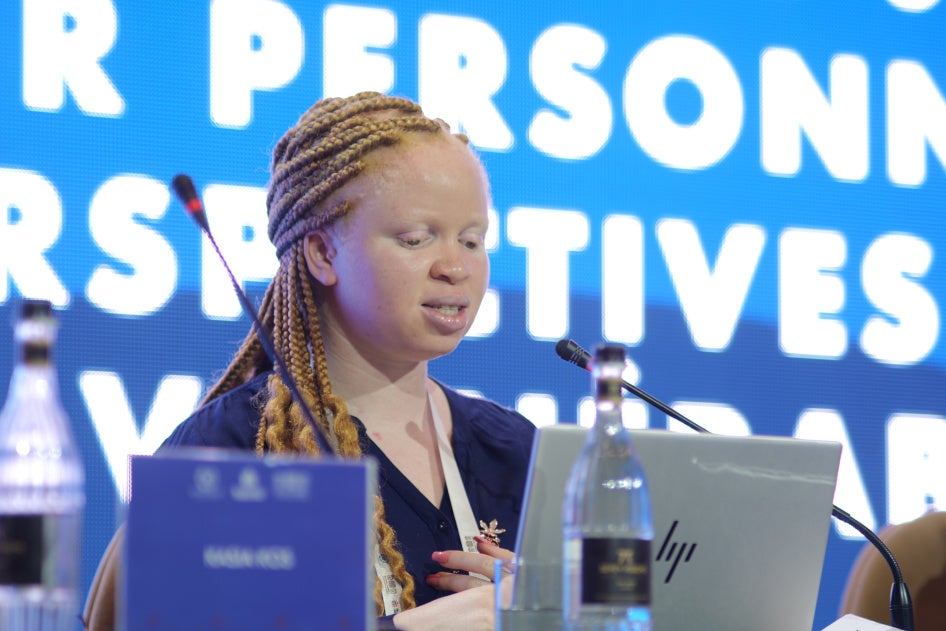
Macheso is an emerging advocate for the rights of young people with disabilities in Malawi. She has played a key role in strengthening national and regional disability rights movements through her work with the Association of Persons with Albinism in Malawi (APAM), the Southern African Development Community (SADC) Youth Parliament, the EU Malawi Youth Sounding Board, and the University of Malawi’s Disability Rights Clinic.
“We are absolutely thrilled about Hilda’s selection,” said Elizabeth Kamundia, disability rights director at Human Rights Watch. “Her leadership advancing the rights of people with albinism in Malawi is both courageous and urgently needed. Hilda brings insight, compassion, and determination to her work, and her advocacy is a beacon of hope for people with disabilities facing discrimination and stigma across the region.”
Over the past several years, Macheso has contributed significantly to disability advocacy efforts in Malawi, including leading awareness campaigns, coordinating International Albinism Awareness Day events, and supporting youth-focused policy engagement through the EU Malawi Youth Sounding Board. She has also influenced disability rights policy at the regional level through her work with the 3rd SADC Youth Parliament, where she wrote and presented a regional report on youth with disabilities that informed parliamentary resolutions across Southern Africa.
Macheso brings a creative approach to rights-based community engagement. While at the University of Malawi’s Disability Rights Clinic, she helped replace traditional presentations with interactive theater activities that encouraged dialogue and reflection. By using storytelling, role playing, and performance, she has created safe spaces for communities to talk openly about disability, confront harmful stereotypes, and promote more inclusive attitudes.
She has also been a crucial partner to the Human Rights Watch ongoing research in Malawi documenting employment discrimination and economic disenfranchisement of people with albinism. As a translator and research assistant, she helped conduct interviews, facilitated coordination with local communities, and ensured respectful, accurate engagement with people with albinism who had experienced discrimination.
“I want people with albinism to be seen, valued, and included,” Macheso said. “We have rights, we have dreams, and we deserve real opportunities to learn, to work, and to live with dignity. This fellowship is a chance for me to grow as an advocate and bring stronger visibility and justice to my community.”
Macheso’s activism comes at a time when the rights of people with albinism face ongoing challenges in parts of Africa. People with albinism experience violence linked to harmful myths and superstitions, as well as entrenched discrimination in education, access to health care, and employment. These systemic barriers often leave people with albinism facing social and economic marginalization, struggling to stay in school, secure decent work, and participate fully in community life.
Macheso was selected from a competitive pool of candidates nominated by Human Rights Watch staff for their disability rights leadership. As part of her fellowship, Macheso will receive training in research, advocacy, communications, and fundraising from Human Rights Watch colleagues. The fellowship further provides opportunities to strengthen her networks with other organizations and advocates.
Human Rights Watch established the fellowship to honor the disability rights icon Marca Bristo, founder of Access Living and inaugural chair of the Human Rights Watch disability rights advisory committee. Bristo was a key advocate for the adoption of the 1990 Americans with Disabilities Act and helped shape the Human Rights Watch disability rights strategy. She encouraged Human Rights Watch to actively involve people with disabilities in its work and to invest in the development of emerging disability rights activists.
Previous Marca Bristo fellows have continued to promote disability rights with added skills to do their work more effectively. The 2024/2025 fellow Benon Kabale and the 2023/2024 fellow Mariana Lozano briefed states parties to the United Nations Convention on the Rights of Persons with Disabilities about promoting autonomy for people with psychosocial and intellectual disabilities.
In March 2024, the 2022/2023 fellow Benafsha Yaqoobi received the International Women of Courage Award from the US Department of State for her extraordinary achievements advocating for the rights of women with disabilities in Afghanistan. As part of the 2021/2022 fellowship, Bryan Russell, a Peruvian activist for political rights, helped raise awareness in countries such as Mexico about the need for greater political representation of people with intellectual disabilities.
Hauwa Ojeifo, Marca Bristo inaugural fellow in 2020 and founder of She Writes Woman, a movement that gives mental health a voice in Nigeria, received funding from Melinda French Gates to advance the health and wellbeing of women based on her achievements.
“Hilda represents exactly the kind of bold, community-rooted leadership the Marca Bristo Fellowship was created to support,” said Daisy Feidt, executive vice president of Access Living. “Her advocacy for people with albinism in Malawi is both powerful and necessary, and her voice will be an important addition to global disability rights movement. We are thrilled to welcome her as the next Marca Bristo Fellow.”