

When European Commission President Ursula von der Leyen asked EU’s newly appointed top diplomat Kaja Kallas in September 2024 to develop a “renewed approach to the Sahel,” she sent a clear signal: the European Union should put an end to an erratic policy toward the West-African region that undermined its core interests to security and stability.
Since a series of military coups in Mali, Burkina Faso, and Niger, the EU engagement in the Sahel has dramatically changed. Most EU military and capacity-building missions have been closed, development aid has been largely frozen, and diplomatic relations with the ruling juntas have been significantly downgraded.
The disengagement has eroded the EU’s ability to shape security and stabilization efforts in the embattled region, where extremist armed groups are increasingly gaining ground.
Creating a new strategic approach has been assigned to Portugal’s former foreign minister and an experienced diplomat, João Cravinho, appointed EU’s representative for the Sahel a year ago. The EU’s hands off approach in the face of instability and conflict in the Sahel needs to shift for the EU’s own security. But for this reboot to matter, Brussels should recognize that there will be no security and stability unless the need to protect civilians is at the center of its renewed approach.
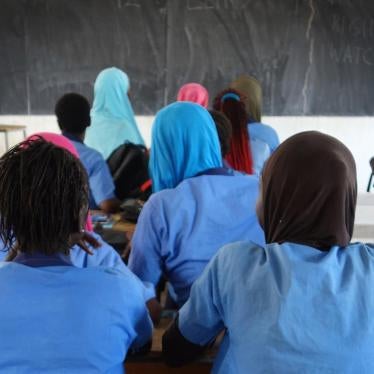
The increasingly abusive conflicts between Islamist armed groups and government forces, and deepening repression since the coups in all three countries, have exposed civilians to countless atrocities and great peril. In each country, civilians have faced a surge of deadly attacks by Islamist armed groups and abuse by military forces and their allies. In Mali, the Al Qaeda-linked Group for the Support of Islam and Muslims (JNIM) has besieged the capital, Bamako, cutting fuel supplies and pushing the junta to shut down schools and universities.
In Burkina Faso, the military and allied militias have carried out abusive counterinsurgency operations that resulted in mass killings of civilians and other serious abuses that may amount to crimes against humanity.
In Niger, the Islamic State in the Sahel Province has escalated attacks on civilians in the west, executing hundreds of villagers and burning down dozens of homes.
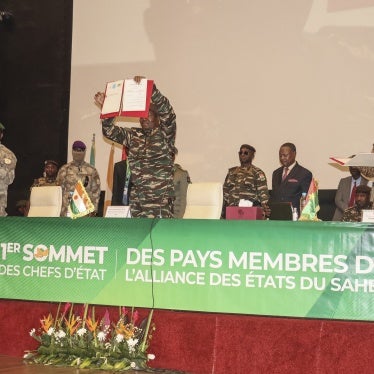
In all three countries, authorities have cracked down on the media, political opposition, and peaceful dissent, forcibly disappearing, detaining, and sometimes unlawfully conscripting critics. Mali’s junta has also banned all political parties, diminishing hope of transition to civilian democratic rule. The juntas are slowly and perhaps inexorably closing all civic space.
At the same time, the juntas have embraced and promoted anti-Western discourse and moved away from regional and international institutions, including by leaving the Economic Community of West African States (ECOWAS), and indicating their intention to leave the International Criminal Court.
After years of fragmented policies, bilateral initiatives and lack of a unified, coherent voice, a renewed EU strategy can be an important opportunity to bring the EU back in the game, provided it puts the security and well-being of civilians at the center of its objectives and public narrative.
There can be no stability while civilians are deliberately targeted, no security cooperation with governments committing crimes with impunity; and no legitimacy if the EU turns away from the suffering of conflict-affected populations.
First, the EU’s renewed strategy should clearly state that all government forces and their allies must act to protect all civilians at all times. This principle should be non-negotiable.
Second, the EU should focus on supporting victims of serious human rights violations, including through humanitarian aid, health care, and psychological support, and access to justice for them and their families.
Third, justice and accountability should be central to any EU engagement. Independent oversight of security forces, investigations into crimes, and remaining International Criminal Court members should be essential conditions for any future security partnership.
Finally, the EU should support civil society groups, human rights defenders, journalists, and researchers – who could help bring Mali, Burkina Faso, and Niger back on the path of human rights and the rule of law. Brussels’ strategic credibility in the Sahel will be judged not just by its security footprint, but by its willingness to act for dignity, accountability, and justice.
Rooting its renewed approach in such principles is not merely idealistic: it is essential and feasible. This is the message that should be sent to junta leaders. It is also the message of hope that civilians bearing the brunt of the region’s tragic situation are entitled to hear.