Dear Prime Minister Takaichi,
Congratulations on your appointment as Japan’s prime minister. We warmly welcome the historic milestone of the first woman to become prime minister of Japan.
Human Rights Watch is an independent nongovernmental organization dedicated to defending and protecting human rights. We monitor and report on violations of international human rights and humanitarian law in about 100 countries around the world.
Many people in Asia face severe oppression. These include: Uyghurs, Tibetans, and Mongolians in China; abductees and people trying to flee North Korea; Rohingya and others in Myanmar opposed to the military junta; and Afghan refugees and other refugees and asylum seekers in host countries in the region.
Given the current geopolitical situation, Japan is positioned to take a leadership role in addressing rights abuses and promoting civilian democratic rule and the rule of law across Asia and the world, in line with its commitments and pledges.
We are writing to urge you to make Japan’s long-stated Human Rights Diplomacy a reality. We have included several recommendations to help address the human rights situation in China, North Korea, Myanmar, and Cambodia, as well as Magnitsky-style sanctions, policy on trade and business, transnational repression, foreign assistance, and institutional reform.
Thank you for your consideration. We look forward to a constructive relationship with your government and would be pleased to discuss these and other matters of mutual concern with you and members of your administration at any time. We can be reached at .
Yours sincerely,
Elaine Pearson
Asia Director, Human Rights Watch
Kanae Doi
Japan Director, Human Rights Watch
Japan’s Foreign Policy & Human Rights
Adopting Magnitsky-style Sanctions Law
Japan is the only Group of Seven (G7) country without a so-called global Magnitsky-style law, which allows governments to sanction human rights violators abroad including via visa bans and asset freezes. You previously supported the introduction of a Magnitsky-style sanctions law, as did the Nonpartisan Parliamentary Association for Reconsidering Human Rights Diplomacy, the Liberal Democratic Party Foreign Policy Committee’s Human Rights Diplomacy Team, and others.
We urge your government to:
- Adopt a global Magnitsky-style sanctions law, which will allow Japan to impose targeted sanctions on serious human rights abusers abroad.
Trade Policy, Business, and Human Rights
Millions of people worldwide work in global value chains, and many face abuses such as forced labor, child labor, sexual harassment, exposure to toxic substances, retaliation for organizing, and low wages. While Japan has non-binding 2022 Guidelines on Respect for Human Rights in Responsible Supply Chains, it has not yet introduced mandatory human rights and environmental due diligence to address value chain abuses supplemented by other relevant measures, including import or export bans to curb egregious human rights abuses such as forced labor and deforestation.
We urge your government to:
- Legislate import and export bans on goods produced through means involving forced labor and deforestation.
- Introduce legally binding mandatory human rights due diligence for companies and environmental due diligence for Japanese companies operating domestically and abroad as well as foreign companies operating in Japan.
- Institute trade policy reforms including processes to suspend or withdraw tariff preferences for serious and systemic human rights violations and take the following additional steps before signing new trade agreements or renewing existing ones: (a) ensure an independent human rights and environmental impact assessment of a proposed trade agreement; (b) exclude investor-state dispute settlement provisions, which grant investors the right to sue states that could negatively affect human rights; (c) ensure the agreement contains enforceable human rights obligations on businesses and investors in all relevant countries covered in the trade agreement; and (d) includes provisions for transparent, independent monitoring and enforcement of human rights provisions.
International Justice and Rule of Law
Japan has long emphasized the importance of the rule of law in its diplomacy. However, it still needs to take steps such as acceding to key international treaties, including the Genocide Convention, and incorporating them into domestic law. Recently, actions by certain governments and other actors flagrantly disregarding the rule of law have become more common, including threats and attacks against the International Criminal Court (ICC), an institution long supported by Japan and led by the Japanese judge Tomoko Akane. In February, in addition to arrest warrants issued by Russia against ICC officials in 2023, United States President Donald Trump issued an executive order authorizing sanctions on ICC officials and others supporting the court’s work; the US government has so far imposed sanctions on nine ICC officials, one United Nations rights expert, and three civil society organizations. These attacks undermine the foundations of the international justice system established since World War II and the international human rights framework. While Japan has engaged the US government bilaterally on this issue and has joined other governments in a public statement condemning the Russian arrest warrants, it has yet to publicly condemn the US sanctions, including by not joining cross-regional statements issued by ICC members since the executive order.
We urge your government to:
- Accede to the Genocide Convention.
- Use every opportunity to publicly express strong support for the ICC, condemn the US sanctions, and call on President Trump to revoke the executive order authorizing them.
- Accede to the 2002 Agreement on the Privileges and Immunities of the ICC.
- Take concrete measures to protect the court, its officials, and those cooperating with it from the effects of any coercive measures, including sanctions, taken against them.
- Provide the ICC with the resources it needs to carry out its critical work across its docket.
Transnational Repression
For decades, Human Rights Watch has documented “transnational repression,” or governments reaching outside their borders to silence or deter dissent by committing human rights abuses against their nationals or members of the diaspora. Governments have targeted human rights defenders, journalists, civil society activists, and political opponents, among others, deemed to be a security threat. Recent research by Human Rights Watch shows China and Cambodia have targeted Chinese and Cambodian dissidents living in Japan.
Transnational repression is not new, but it has often been downplayed or ignored and warrants global, rights-centered action. In June, the UN Human Rights Office issued its first guidance on the issue, and G7 countries, including Japan, pledged to act.
We urge your government to:
- Publicly denounce cases of transnational repression when it is safe for the victims and their communities to do so.
- Establish a national system to track domestic cases of transnational repression with appropriate safeguards for individuals’ privacy and to ensure the protection of asylum seekers and refugees, and with the ability for citizens to report experiences and concerns, anonymously if needed.
Foreign Assistance
Earlier this year, the Trump administration terminated funding for most US foreign assistance programs implemented by the US State Department and US Agency for International Development (USAID). As a result, hundreds of civil society and humanitarian groups or programs have had to curtail or end operations. Despite supposed humanitarian waivers for lifesaving aid programs, including parts of the President’s Emergency Plan for AIDS Relief (PEPFAR), most programming remained suspended through 2025, in large part due to massive staffing disruptions at USAID and the State Department, and highly bureaucratic restrictions placed on its payment and contracting systems.
The impact of these cutbacks has been catastrophic, affecting the delivery of live-saving medicines to treat HIV and prevent mother-to-child HIV transmission of newborns across the world, emergency food and medical assistance programs in areas facing famine or acute food insecurity, and emergency protection programs to help at-risk refugees.
Cuts have been causing other devastating human rights consequences around the globe. They have hit human rights fact-finding groups conducting vital monitoring and investigation into rights violations and war crimes, independent media working to expose human rights abuses and corruption, and organizations providing legal services for victims of politically motivated prosecutions by authoritarian governments.
We urge your government to:
- Increase emergency humanitarian aid and foreign assistance for refugees and other vulnerable groups, especially regionally, including from Myanmar and Afghanistan, by increasing or reprioritizing funding for key UN humanitarian agencies and independent humanitarian groups.
- Increase voluntary funding for UN and other multilateral institutions that engage in vital work to address human rights crises, armed conflict, epidemics, and climate change, including the UN Office of the High Commissioner for Human Rights (OHCHR), UN Children’s Fund (UNICEF), UN High Commissioner for Refugees (UNHCR), and the World Health Organization (WHO).
- Reform Japan’s Official Development Assistance (ODA) frameworks to allow more robust and direct funding to civil society organizations and human rights defenders, independent media groups working on authoritarian countries (including in exile), and other nongovernmental organizations working on human rights and humanitarian issues. In authoritarian countries, the government should adopt policy to allow funding for groups being persecuted by the authorities. Where needed, the government should use foreign assistance to support international or Japanese groups that provide grants to relevant programs.
Strengthening Institutional Structures
The Japanese government has stated that “human rights are universal values and that the protection of human rights is the basic responsibility of all countries, regardless of differences in the method of achieving this goal and their cultures.” To make Japan’s long expressed Human Rights Diplomacy a reality, the government should strengthen its institutional structures that promote human rights.
We urge your government to:
- Adopt a substantive, high-level, and robust human rights action plan that guides Japanese foreign policy. Use this plan to adopt concrete actions with specific time frames for countries facing serious human rights problems.
- Improve the Foreign Ministry’s structure and increase resources to enable it to carry out more effective human rights diplomacy under the leadership of dedicated high-level personnel.
- Establish and fund a program to support human rights defenders and open civic space abroad.
- Publish an annual human rights report on key country situations, such as those prepared by the US, the United Kingdom and the European Union.
China
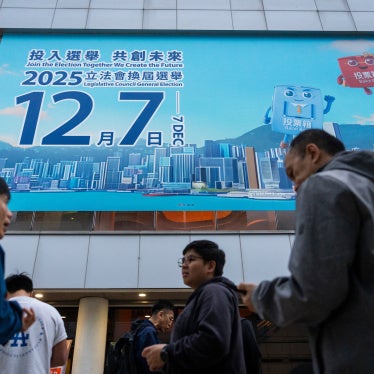
Over a decade into Chinese President Xi Jinping’s rule, efforts to centralize control have led to heightened repression throughout the country. There is no independent civil society, no freedom of expression, association, assembly or religion, and human rights defenders and other perceived critics of the government are persecuted. The Chinese government considers culturally and ethnically distinct Tibetans and Uyghurs as threats and subjects them to particularly harsh repression. Hundreds of thousands of Uyghurs remain imprisoned as part of the government’s crimes against humanity in the region. It is also eroding Mongolians’ distinct identity in Inner Mongolia and has ended long-protected civil liberties in Hong Kong. The Chinese government has also subjected critics abroad, including those in Japan, to threats and intimidation for exercising their basic rights.
We urge your government to:
- Press the Chinese government to end its severe repression and forced assimilation in Xinjiang, Inner Mongolia, and Tibet.
- Publicly speak out on the rights of Tibetans to exercise their religious freedom and press the Chinese government to free the Panchen Lama, who has been forcibly disappeared along with his family since 1995.
- Press the Chinese government to release pro-democracy activists and human rights defenders in Hong Kong and mainland China.
- Protect Japanese residents and citizens from Chinese government's repression beyond its borders and take steps to prevent its recurrence.
North Korea
The Democratic People’s Republic of Korea (North Korea) is one of the most repressive countries in the world. The 2014 UN Commission of Inquiry report found that North Korea’s widespread abuses—including the abduction of people in Japan—amount to crimes against humanity. Under totalitarian leader Kim Jong Un, North Korea maintains fearful obedience through arbitrary punishments, torture, executions, unjust imprisonment, and forced labor. Sexual and domestic violence against women and girls is widespread and normalized. Basic freedoms, including expression, assembly, and access to information, are severely restricted. In 2025, rights restrictions continued amid economic decline, intensifying hunger, and growing social inequality, while the government prioritized weapons development. From 1959 to 1984, North Korea’s deceptive “Paradise on Earth” campaign lured about 93,000 Zainichi Koreans and Japanese to move to North Korea under false promises. Japanese courts have since recognized North Korea’s responsibility for abuses against victims of this program.
We urge your government to:
- Support and strengthen UN mechanisms engaged in monitoring and documentation of violations to ensure that evidence and information are preserved for future accountability processes.
- Demand to allow the return of all the victims of abduction and the “Paradise on Earth” campaign and their family members still in North Korea.
- Provide sustained, flexible financial support to independent civil society organizations around the world assisting North Korean human rights defenders and survivors of abuses — including groups in Japan that document abuses, pursue accountability, support family tracing and safe reunification of abductees and “Paradise on Earth” victims and their relatives.
Myanmar
The Myanmar junta has ramped up its unlawful attacks against civilians in response to the growing armed resistance and territorial losses. The junta’s atrocities committed since the February 2021 military coup amount to war crimes and crimes against humanity, fueled by decades of impunity. The junta's atrocities, mass displacement, aid cuts, and economic collapse have created a humanitarian catastrophe. Ethnic Rohingya are currently facing the gravest threats since the military’s 2017 atrocities. Refugees from the conflict are increasingly fleeing to neighboring countries and elsewhere in South and Southeast Asia.
This year the junta began preparing for supposed elections that are scheduled to start in late December. In preparation, the junta in July lifted its state of emergency but intensified its crackdown on political opposition and peaceful dissent and issued a new law that bans protests or criticism of the election, with punishments that include the death penalty.
We urge your government to:
- Uphold Japan’s expression of concern about the junta’s supposed elections, and persuade other governments, including Thailand and other The Association of Southeast Asian Nations (ASEAN) member states, South Korea, and India to publicly rebuke the junta’s election plans and not provide technical support.
- Expand funding through independent humanitarian agencies to address the humanitarian crises in Myanmar and refugee camps in Bangladesh and Thailand, including by channeling aid through cross-border efforts. Bolster support for aid agencies, human rights defenders, and local civil society groups.
Cambodia
In 2023, Hun Sen, who had been prime minister since 1985, handed over the premiership to his son Hun Manet. Cambodia remains effectively a single-party state with fixed and controlled elections, with the ruling Cambodian People’s Party (CPP) controlling all state institutions, including the judiciary. The Cambodian government continues to harass and prosecute critics of the government, including those outside the country. The authorities also tightly restrict the rights to freedom of expression, association, and peaceful assembly.
We urge your government to:
- Call on the Cambodian government to protect fundamental freedoms including the rights to freedom of expression, the media, peaceful assembly, and association, as Japan previously did in 2024.
- Call on the Cambodian government to amend the Trade Union Law, the Law on Associations and Non-Governmental Organizations (LANGO) and any other relevant legislation to align it with international human rights and labor standards, ensure the protection of workers, and respect the freedom of expression and role of civil society.